
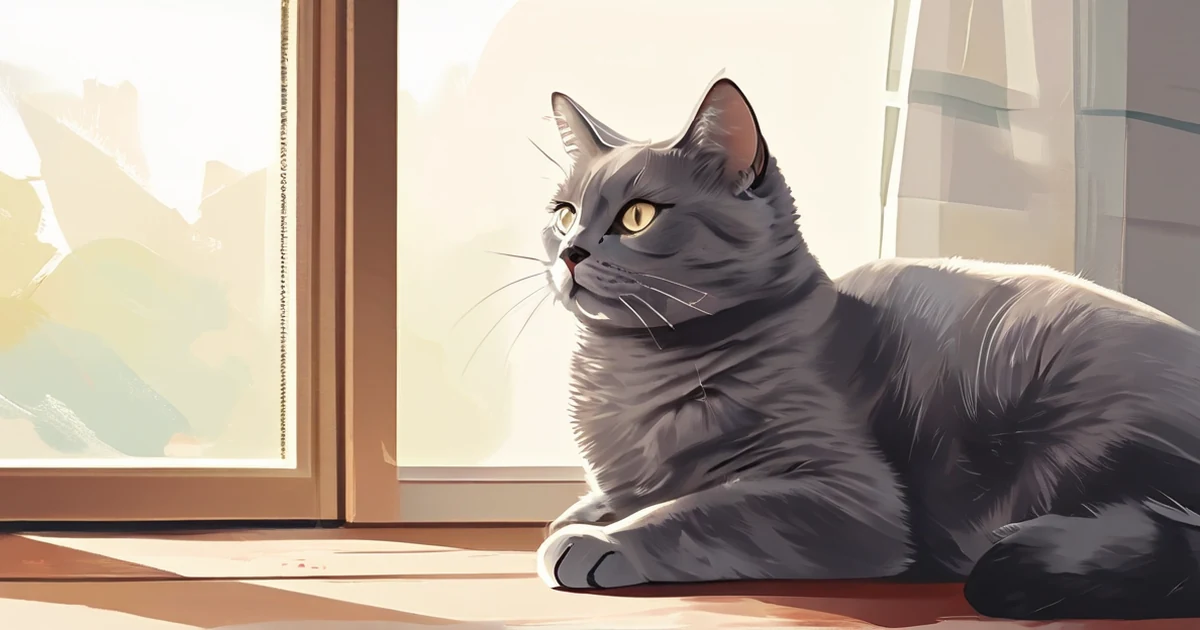
The short answer: no cat is completely shed-free. Ranked by how much loose hair actually lands on your floor, the Sphynx, Devon Rex and Cornish Rex come first. But if you are looking for a low-shedding cat because someone in the house is allergic, the premise needs fixing: the thing that makes people sneeze is not hair, it is a protein called Fel d 1 in cat saliva and skin oils. That is why a hairless cat can still trigger a reaction, and why some coated breeds such as the Russian Blue are the cats allergy-prone owners actually end up living with.
1. Which cat sheds the least? Start with the Sphynx
By visible shedding alone, the Sphynx wins. Its coat is a fine peach-fuzz down, warm and suede-like to the touch, and you will struggle to find a single hair on the sofa. The trade-off is concrete — you are not skipping grooming, you are trading a brush for a washcloth.
- Oil: with no coat to absorb sebum, the skin develops a film that transfers to furniture. Most owners wipe the cat weekly, bathe every two to three weeks, and clean waxy buildup from the ears.
- Temperature and sun: Sphynxes thermoregulate poorly. They need sweaters and heated beds in winter, and pale skin burns in direct summer sun.
- They still shed something: skin flakes. Dander is the main vehicle for Fel d 1, so an allergic owner sneezes just as much as with a coated cat.
The Donskoy and Peterbald are the same story — near-hairless mutations with identical care needs. See our Sphynx breed profile.
2. Cat breeds that don't shed much: three groups, three reasons
Remembering names is less useful than understanding why a coat sheds little — breeds in the same group behave the same way in your home.
- Naturally hairless: Sphynx, Donskoy, Peterbald. Shedding close to zero; grooming effort and skin issues the highest of any group.
- Curly single coats: Devon Rex and Cornish Rex. They lack the stiff guard-hair layer, leaving only soft undercoat, so shed hairs curl into the coat instead of drifting onto the floor. The skin gets greasy, ears need cleaning, and the coat is too thin for cold rooms.
- Close-lying short coats: Siamese, Russian Blue, Bengal, Singapura. Short hair held tight to the body means less volume and what does come out stays in a clump you brush away in one pass.
To compare coat, build and temperament breed by breed, our breed districts cover twenty of them.
🐱 Tip: part the fur at the shoulder. Stiff guard hairs over a thick downy undercoat means a cat that blows coat twice a year. A single soft layer means low shedding but oily skin.
3. What is a "non-shedding" cat, really? Two myths
Myth one: hairless means hypoallergenic
Only the first half is true. Allergens travel on dander and saliva, not on hair. A hairless cat removes the vehicle, not the cargo — and with no coat soaking up oil, the places it rubs against end up carrying more Fel d 1, not less.
Myth two: short hair means less shedding
Short-coated cats split into two types. Single-coat breeds like the Siamese or Russian Blue genuinely shed little. Double-coated short hairs — British Shorthair, American Shorthair — carry a dense downy undercoat and can produce a palm-sized ball of fur in one brushing during seasonal change, with stiff short hairs that weave into upholstery. Long-haired cats like the Maine Coon shed plenty, but in tufts: visible and sweepable. "Easy to manage" and "sheds little" are different scores.
4. Cat allergies come from Fel d 1, not from fur
This is the part that changes the decision. Fel d 1 is produced in sebaceous glands, salivary glands and skin cells. Cats spread it over the coat while grooming, and once the saliva dries it travels on dander particles small enough to stay airborne. A few properties surprise people:
- It sticks: Fel d 1 lodges in curtains, upholstery, clothing and walls and persists for months. Symptoms often continue for weeks after a cat leaves a home.
- Hormones matter: intact male cats produce the most; neutering reduces levels noticeably.
- Coat length barely matters: hairless cats remove a carrier, not the source.
- It is common: surveys put cat allergy at roughly one in ten to one in five adults.
So does "anti-allergen" cat food work? There is a real category built on feeding cats an egg-derived antibody against Fel d 1, which reduces the protein in saliva. Published studies show measurable drops on cat hair and dander — a reduction, not elimination. Useful as one layer of an allergy plan, never a licence to sleep with the cat on your pillow.
5. Hypoallergenic cat breeds: a realistic shortlist
No breed comes with a guarantee, only individuals with a lower probability. These are the ones allergy-prone owners mention most:
- Russian Blue: the most frequently recommended coated breed. Small studies measured lower Fel d 1 output, but variation within the breed is huge.
- Siberian and Balinese: some individuals test well below average. Sample sizes are small, so treat it as promising rather than proven.
- Siamese and Oriental Shorthair: low shedding, less dander, easy coat care — but they still produce allergen.
Testing the individual beats choosing a breed. Spend at least half an hour at a breeder's or shelter, ideally on two or three visits, handle the cat, then touch your face and see what your body does. Adult, neutered cats have more stable levels than kittens, so favour them.
Environment changes usually deliver more relief than a breed swap. In order of payoff:
- Make the bedroom a cat-free zone — eight hours a night without allergen is the biggest single win.
- Run a HEPA air purifier in the room the cat uses most.
- Wash throw blankets and sofa covers weekly in hot water; remove carpet where you can.
- Wash your hands after handling the cat, and brush it wearing gloves outside the bedroom.
Medically, the only intervention that can change the course of the disease is allergen immunotherapy, which takes years and needs an allergist. "You get used to it" is true for some people and, for others, is how a mild itch becomes chronic rhinitis.
If you already live with a low-shedding cat, two habits cover most of it: a daily brush-out, and a weekly wash of whichever blanket the cat has claimed. Further reading: our test of five free cat tablet games.
🎮 Play free — no download