

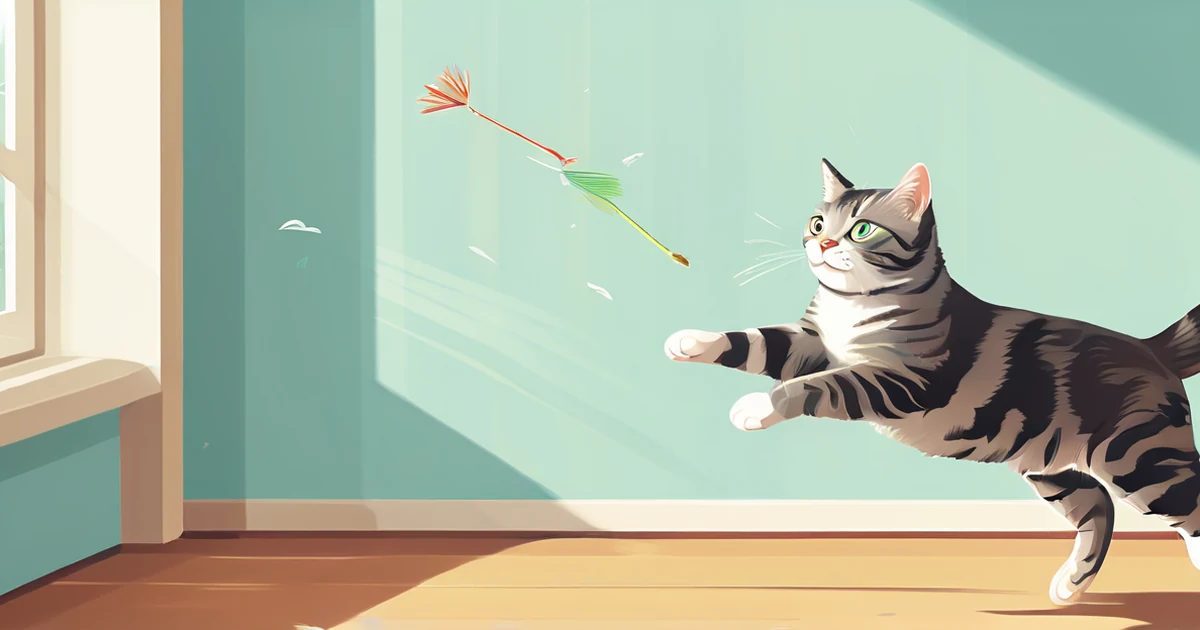
Here is the bottom line: a cat's tail is a live readout of emotional intensity. Straight up means confidence and greeting, slow swaying means focus, fast lashing means irritation, a puffed bottle-brush tail means fear rather than anger, and a tail clamped low means the cat wants to disappear. Cats cannot talk, and flat-faced breeds make facial expressions harder to read, so the tail is usually the most reliable signal an owner has. Below are the most common positions, what kittens do differently, and a three-step method for reading the whole cat instead of one body part.
The Tail Up: Confidence, Greeting, and the Question Mark
A tail held straight up is the friendliest signal in a cat's entire vocabulary. It goes back to kittenhood, when kittens approach their mother with the tail raised, and adult cats keep using it with people they trust. If your cat walks toward you with a vertical tail, that is a greeting, not a demand for food. A straight-up tail with the tip curled into a hook — a feline question mark — adds curiosity: the cat is interested in what you are doing and may accept an invitation to interact. A vertical tail that trembles slightly is a higher-energy version of the same greeting, most common at the door when you come home. This upright posture also happens to be the easiest moment to photograph a cat, because the cat stops and holds still; timing tips are in our guide to photographing your cat.
A Field Guide to Common Tail Positions
Every guide lists a slightly different set, but eight positions cover almost everything you will see in a normal home:
- Straight up: confident, friendly, open to contact.
- Question-mark tail: curious and playful — a good moment to start a game.
- Slow sway, tip only: focused attention with a hint of hesitation, typical of a cat watching birds through a window.
- Fast, wide lashing: irritation rising. This is the classic "stop petting me" warning.
- Puffed bottle-brush tail: fear or startle, not aggression for its own sake.
- Tail clamped between the hind legs: fear and submission, common in unfamiliar surroundings.
- Loose and still on the floor: relaxed, no tension anywhere.
- Wrapped around your arm or leg: a social touch, the feline version of a hug.
The same movement can drift in meaning depending on context: a small, slow sway is focus, while a wide, fast one is irritation. That is why the tail should never be read alone — the three-step method at the end pairs it with ears and eyes.
Twitching, Lashing, and Puffed Tails: What the Movement Means
Separate amplitude from speed. Small and slow means concentration; large and fast means patience is running out. The most common real-world example: you are petting your cat, everything seems fine, and the tail suddenly starts slapping the floor. That is an escalation warning, and the right response is to stop touching the cat immediately. Cats whose warnings are ignored often escalate to a grab or a bite, which owners then describe as unprovoked — it was not; the tail announced it first.
A puffed tail is a startle reflex, not anger: tiny muscles pull the fur upright so the cat looks bigger to whatever startled it. Look for the trigger — a dropped pan, a strange dog, another cat outside the window — and give the cat space instead of picking it up. A clamped tail is the same fear pointed downward; forcing interaction with a frightened cat only teaches it that you are unpredictable. One pleasant exception: a tail held up with a slight tremble, often paired with purring, is contentment rather than stress. Do not confuse it with the stress purring described in our article on why cats purr.
Kittens: Same Signals, Weaker Control
Kitten tails read like adult tails with two adjustments. First, motor control is still developing: a two-month-old kitten in full play mode will whip its tail wildly and even chase its own tail, which is clumsiness rather than irritation. Second, clamped tails are far more common in kittens newly arrived at a home; most relax within a few days as the environment becomes familiar. If a kitten is still hiding with a low tail a week later, reduce noise and foot traffic instead of pushing more handling. Early, gentle social contact is what teaches kittens to moderate these signals in the first place — tail fluency is learned, not purely innate.
The Three-Step Method: The Tail Is Only One Third
The tail tells you how strong the emotion is; the ears and eyes tell you which way it points. Read them in this order:
- Ears first. Forward means interest; flattened to the sides means unease; pinned back tight means fear or an imminent swat.
- Eyes and body weight next. Wide pupils with the body crouched low point to fear; wide pupils with weight loaded forward point to a hunt about to start.
- Tail last, for intensity. The same unease is one grade more serious when the tail is clamped than when it simply hangs low.
Reading tails correctly spares you the two classic mistakes: interrupting a cat that was merely focused, or mistaking a warning for an invitation and getting bitten. Cats with unused energy produce far more lashing tails, and the cheapest fix is two short predatory play sessions a day; if you are busy, open a free online cat toy game and let the cat chase the screen for five minutes. For more body language, pair this with our guides to kneading and purring — together they cover most of what a cat is quietly telling you.
🎮 Play free — no download