

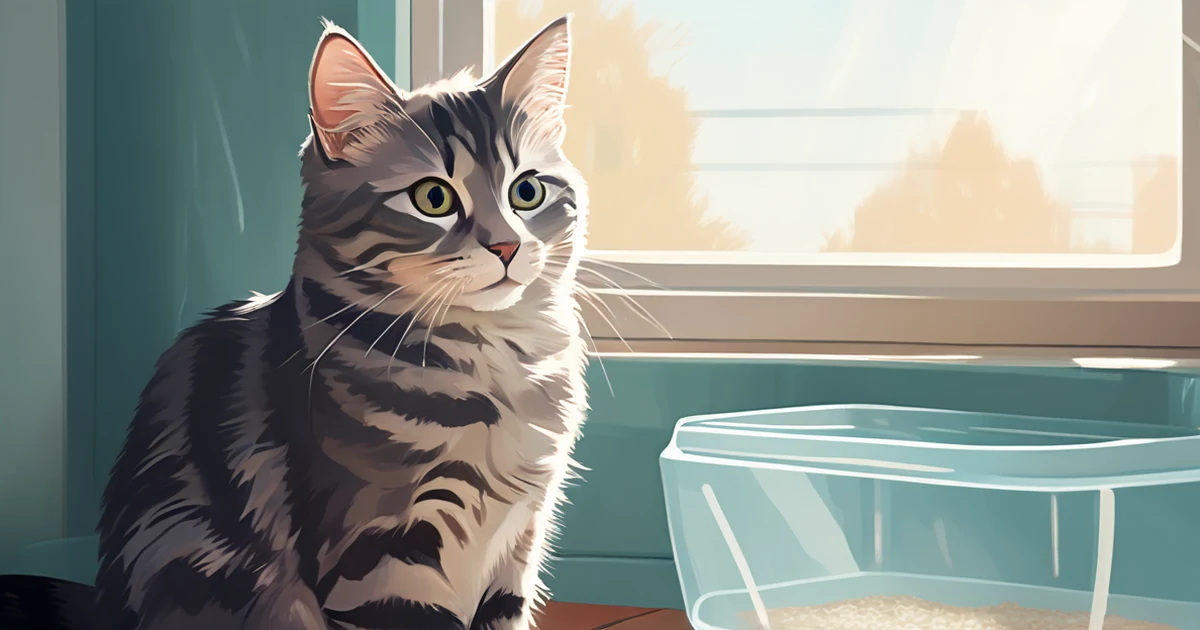
Start with the vet, not with a training plan. A cat that suddenly urinates outside the box should be treated as medically unwell until proven otherwise, because lower urinary tract disease, kidney problems and diabetes all present this way. The exception that cannot wait for an appointment is a male cat crouching in the box over and over with little or nothing coming out: that is a urethral obstruction, it is painful, and it can become fatal within a day or two. Once your vet has ruled out disease, most remaining cases trace back to the box itself — too few, too small, too dirty, in the wrong place, or sitting on a spot that already smells like a toilet.
Rule Out a Medical Cause Before Anything Else
Feline lower urinary tract disease (FLUTD) is the single most common medical explanation. It covers idiopathic cystitis, bladder stones, crystals and infection, and the classic picture is a cat visiting the box frequently, producing only a few drops, staying crouched for a long time, or leaving blood in the urine.
- Urethral obstruction — mostly male cats. Repeated unproductive trips, crying, hiding, vomiting, lethargy. This is an emergency; go to a clinic the same day.
- Diabetes and hyperthyroidism — total urine volume rises sharply, so the box fills faster than the cat can keep up with.
- Chronic kidney disease — common in older cats, along with increased thirst and weight loss.
- Arthritis and cognitive decline — a high-sided box becomes hard to climb, or the cat genuinely loses track of where it is. Senior cats are often labelled "naughty" when the real issue is pain or mobility.
Expect a urinalysis first, with imaging and bloodwork if indicated. Do not start urinary "support" supplements before that, because they can mask the signs your vet needs. A consultation plus a urinalysis usually costs far less than treating a blocked cat overnight, which is worth remembering when you weigh the cost of owning a cat.
Spraying and Peeing Are Not the Same Problem
Owners use one phrase for both, but they need different fixes.
- Urinating outside the box: squatting, a normal volume, delivered on a horizontal surface — floor, bathtub, laundry basket, bed. Points to the box or the bladder.
- Spraying: standing, tail up and quivering, a small amount of urine delivered onto a vertical surface such as a wall corner, door frame or the back of a sofa. This is communication, not elimination, and it clusters around intact males and cats in social conflict.
- Peeing on beds and clothing: soft, absorbent, carrying your scent. Anxious or uncomfortable cats are drawn to those textures, so both the medical and the emotional explanations are in play.
Record which one you are seeing — photos, times, posture — and take that to the appointment. "He pees everywhere" is hard to work with; "standing spray on the door frame at 6 a.m., plus normal urine in the box" is a diagnosis waiting to happen.
The Litter Box Checklist Most Owners Miss
If the vet gives the all-clear, the box is the next variable. In rough order of impact:
- Count: one per cat, plus one. Two cats means three boxes, spread across different rooms. Side by side counts as a single box in a household with a conflict.
- Size: at least 1.5 times the cat's length from nose to base of tail. Most boxes sold as "cat-sized" are too small, and a plastic storage bin with a door cut into one side often works better.
- Location: quiet, with an escape route, away from food and water. Next to a washing machine, inside a cupboard, or in a spot where a dog can block the entrance all fail the test.
- Litter: unscented, fine-grained, clumping, 5–8 cm deep. Scoop twice a day and change the whole box regularly. Perfume, deodorising beads and large wood pellets are frequent reasons for refusal, and a hooded box traps odour — a very common cause of abandonment.
Give any change two weeks before judging it. If the cat has already chosen a corner, move a box onto that exact spot, let it settle, then shift the box about 10 cm a day towards where you want it. That single move outperforms every "attractant" spray on the market, and the logic is identical to stopping a cat from shredding the sofa: put the legal outlet where the cat has already decided to go.
Stress, Territory and Multi-Cat Households
Urine is information, so any change in the social map can trigger marking: a new cat, a new baby, a renovation, a neighbour's cat visible through the window, or a household member returning after a long absence. Bullying at the box is easy to miss — one cat simply guards the corridor and the other starts using the hallway instead.
What helps is separation and reintroduction, one more box in a different zone, feeding stations far apart, and vertical space so a lower-ranking cat can move without touching the floor. Synthetic pheromone diffusers are harmless and help some cats, but they are not a substitute for layout. Never confine the cat as punishment: it raises stress, breaks whatever social arrangement exists, and commonly produces more scattered urination once the cat is released. If marking continues after neutering and environmental work, your vet can discuss medication; that is a legitimate option, not a last resort.
Cleaning So the Spot Stops Smelling Like a Toilet
Cats smell urine far better than we do, so a wipe with household cleaner leaves a message that says "bathroom here".
- Use an enzymatic cleaner. It breaks down the uric acid crystals that hold the odour; ordinary disinfectant only cleans the surface.
- Find every spot first. A UV torch reveals dried urine as a yellow-green glow. Mattresses and sofa cushions need soaking, not spraying.
- Skip ammonia-based products, and never pour bleach onto urine. Urine contains ammonia, and residual ammonia reads as an invitation; mixing it with chlorine bleach also releases irritant gas.
- For prevention, citrus and mint deterrent sprays buy a few days at most before habituation kicks in. Patch-test first and never spray the cat.
Finally, give the cat somewhere for the energy to go. Two short predatory play sessions a day reduce anxiety-driven urination noticeably; if you are out of the house, a few minutes of the free cat toy game on a tablet covers the chase instinct, followed by a real toy to catch.
One caution worth repeating: straining, blood in the urine, repeated unproductive trips to the box, vomiting or lethargy all mean a vet visit today, not a behaviour plan. Cats hide pain well, and the cost of waiting is measured in hours.
🎮 Play free — no download