

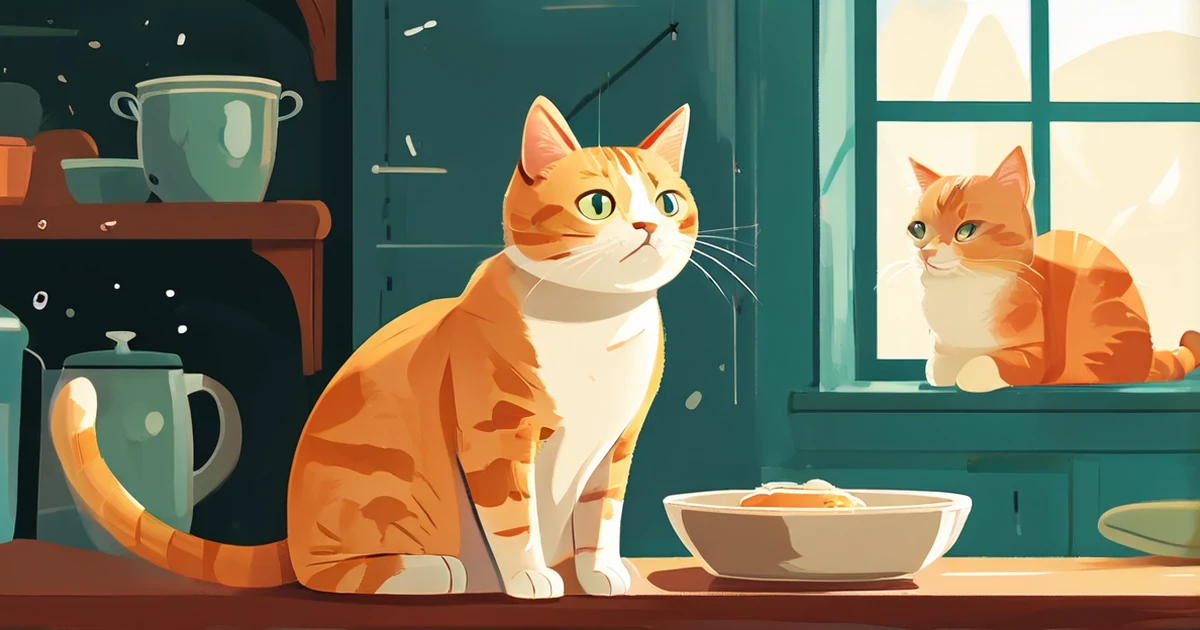
"Nine out of ten orange cats are fat" — or as the meme goes, "Big Orange for a Reason." It's one of the most repeated "facts" about cats on the internet, and there's a real chance it isn't a fact at all. Here's the honest answer up front: no reliable study has ever shown that orange cats weigh more than other cats on average, and there's no evidence that the orange coat gene has anything to do with body weight. What you're most likely seeing is selection bias — not a fat gene. Let's walk through the evidence chain.
Where Does the "Fat Orange Cat" Meme Come From?
Unlike verified breed traits, the chubby orange cat reputation didn't come from veterinary data. It came from jokes: Garfield, "making biscuits on a belly," and an endless stream of viral chonk photos built a stereotype, and the stereotype grew its own vocabulary. A meme is not a measurement. Nobody counted a random sample of cats by coat color and found the orange ones heavier — which is exactly what a claim like this would require. As of today, that study doesn't exist.
This matters because "I've seen a lot of fat orange cats" and "orange cats as a group are heavier" are two very different statements. The first can be true while the second is false — and that gap is exactly where the rest of this article lives.
What the 2024 Orange Gene Study Actually Found
Here's the closest thing to hard science. In May 2024, two research teams — one at Kyushu University in Japan, one at Stanford — published papers in Current Biology pinpointing the mutation behind orange fur: a gene called Arhgap36 on the X chromosome. This was the first time the orange coat gene had been identified, a genuinely big deal for cat genetics.
But there's a detail that rarely makes it into the headlines: the mutated gene was found to be active in pigment cells, and the studies found no evidence that it affects metabolism or body weight. In other words, the one solid piece of genetics we now have tells us the orange gene manages fur color, not the waistline. If someone tells you orange cats are fat because of a gene, the actual research doesn't back that up.
The factors with real evidence behind feline weight gain are environmental: reduced metabolism after neutering, long-term indoor living, and feeding habits. None of these cares what color your cat is. Attributing "fat" directly to "orange" mistakes correlation for causation.
Why Male Cats Skew the Sample
There is, however, one real quirk in orange cat biology worth knowing. Because the orange gene sits on the X chromosome, a male cat needs only a single copy to turn orange, while a female needs two. The result: the overwhelming majority of orange cats — commonly estimated around four in five — are male.
And male cats are, on average, larger than females, and tend to gain weight more easily after neutering. Stack those facts together and the "big orange cat" impression gains a mundane explanation: the average orange cat you meet is drawn from the larger half of the cat population. To be clear, this is a plausible contributing factor, not a proven cause of the meme — no study has specifically tested how much sex composition contributes to the fat-orange-cat image. But it's exactly the kind of boring, reasonable explanation that memes tend to lose to.
Selection Bias: You Remember the Chonks
The biggest factor may have nothing to do with cats at all: how the sample reaches your eyes.
- Fat orange cats are content gold. A round ginger cat posing next to a food bowl is a guaranteed performer on short-video platforms. A lean orange cat doing the same thing gets three likes and a comment asking whether the owner is feeding it. So the orange cats that travel through your feed have been filtered, systematically, for roundness.
- Orange is an attention magnet. In most indoor scenes, a patch of orange stands out far more than gray, white, or black fur. The same cat, in the same body condition, gets noticed more — and gets interpreted through the stereotype.
- Memory filters too. Every fat orange cat you meet confirms the belief; every lean one quietly becomes "the exception." Psychologists call this frequency illusion: once you hold an expectation, you keep finding evidence for it.
Put it all together and "nine out of ten orange cats are fat" starts to look less like biology and more like a meme that survives on biased samples. Our companion piece, why orange cats get fat, covers the universal reasons any cat gains weight. This article answers a different question: why the fat ones you notice all seem to be orange.
So next time someone declares that all orange cats are fat, ask them one thing: have they ever met a lean orange cat that simply doesn't gain weight? And if the orange gene doesn't make cats fat, why does every neighborhood seem to have exactly one suspiciously round big orange — is it the cat, or is it us and the treat jar? That's the question we'd genuinely like to hear your answer to.
Whether your cat is orange, gray, or an unfixable mystery, the best weight plan is the fun one. Everything at CatPawCity plays free in the browser — try the cat merge game and find out whether your cat watches the screen cats with genuine interest, or just walks off toward the food bowl. Honestly, either result tells you something.
🎮 Play free — no download