

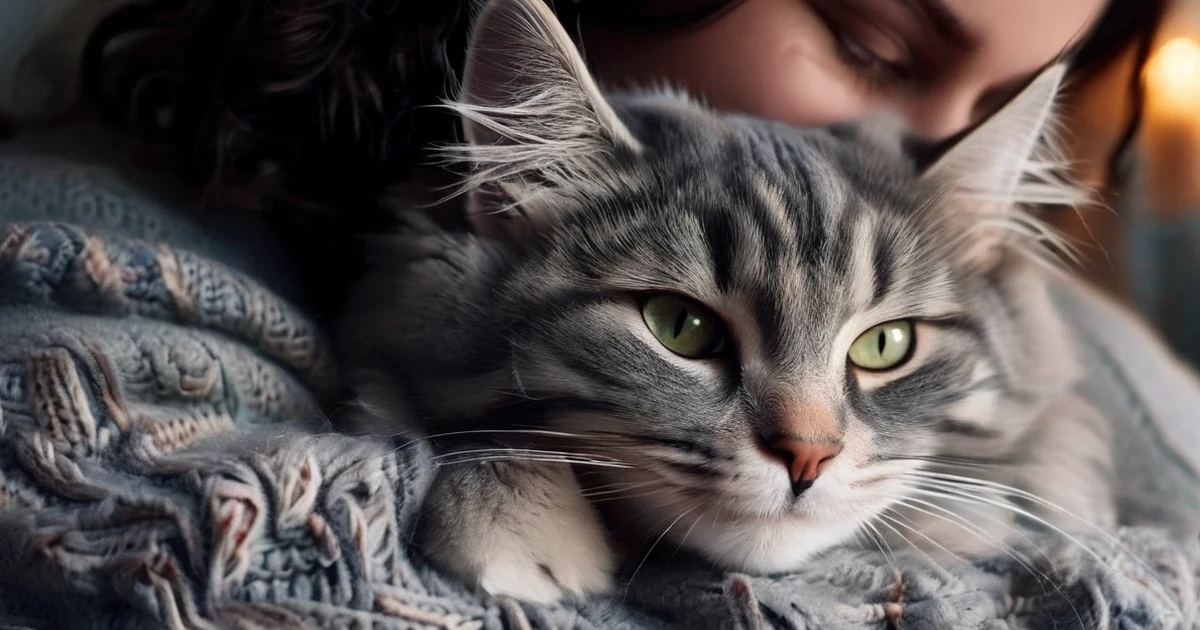
The short answer: a purr is a low-frequency vibration generated by rapid laryngeal muscle contractions, and it usually means contentment — but not only contentment. Cats also purr when they are stressed, in pain, giving birth, or seriously ill. It is better understood as a self-soothing channel that runs across many emotional states than as a single happiness button.
How a Cat Actually Makes a Purr
A purr is not a vocalization in the ordinary sense. The muscles of the larynx contract and release roughly 25 to 30 times per second, opening and closing the glottis so airflow is chopped into pulses. The result is that continuous, low, humming sound.
Two details make purring unusual. First, it happens on both the inhale and the exhale — almost every other cat sound (meow, hiss, yowl, chatter) needs outgoing air. Second, it is a small-cat trick. Domestic cats, cheetahs, lynx and servals purr; lions, tigers, jaguars and leopards generally do not, because of the structure of the hyoid apparatus in their throat. “Big cats can’t purr” is one of the rare pieces of internet cat trivia that holds up.
Volume varies enormously between individuals. Some cats can be heard across a room; others produce a silent purr you can only detect with a hand flat against the throat. Owners regularly conclude their cat never purrs when in fact it purrs constantly at a frequency they cannot easily hear.
Purring Does Not Always Mean Happy
- Contentment. Slow, steady purring while eating, sunbathing, or being stroked in the right place — under the chin, behind the ears, at the base of the tail — usually with half-closed eyes and slow blinking.
- Solicitation. Cats purr to ask for things, and the asking purr is measurably different: higher pitched, more urgent, with an embedded cry that sits close to the frequency of a human infant. That buried cry is hard to ignore, which is presumably the entire point.
- Stress and self-soothing. Cats purr in the car, at the vet, and during thunderstorms. Read the body, not the sound: a stiff posture, dilated pupils, flattened ears and a tucked tail mean the purr is a coping mechanism rather than a compliment.
- Pain and illness. Injured cats, cats recovering from surgery, and cats in labor purr too. A purr therefore never rules out a medical problem, and a cat that purrs nonstop while hiding under the bed deserves more concern than one that is quiet and asleep.
Why Cats Purr When You Pet Them
The most likely explanation is that touch reactivates the kitten-to-mother channel. Kittens purr almost from birth, and it appears to work as a contact signal — a low-frequency “I am here and I am fine” that a mother can pick up through her body as much as through her ears. Adult cats keep the channel and point it at humans. When your cat starts purring the moment your hand lands, it is running a very old program that concludes: this individual is safe.
What about the cat that purrs instantly at any visitor? That usually reflects good socialization during the two-to-seven-week window, when a kitten’s brain is most open to learning that hands are not a threat. It is not a personality test. A high-purr cat can still bite when you touch the wrong spot, and a quiet cat can be deeply attached — some express it by leaning on you, following you from room to room, or hooking a tail around your ankle instead of making any noise at all.
Purring, Snoring and Trilling: Telling Them Apart
Purring is under active muscular control, which is why it fades when a cat drops into deep sleep and stops instantly when it hears a can opening. That on-off behaviour is normal and needs no attention.
Snoring is a different mechanism. It comes from soft tissue in the soft palate and pharynx vibrating during sleep: harsher, more irregular, mostly on the inhale, and especially common in flat-faced breeds such as Persians, Exotic Shorthairs and Himalayans. The trill is a third sound again — the short rolled brrrp a cat uses as a greeting while jumping up to meet you.
See a vet if your cat breathes through an open mouth while asleep, makes a loud whistling or rattling noise, stops breathing for a few seconds and then gasps, pants during the day, or has bluish gums. These can point to narrow nasal passages, an elongated soft palate or heart disease.
In older cats, a new low rumbling purr-like sound combined with weight loss, night yowling and restlessness is worth a check for hyperthyroidism and pain — not a shrug and a joke about the cat getting clingy.
The 25 Hz “Healing” Claim
The popular version goes like this: cats purr between 25 and 50 Hz, that range stimulates bone density and tissue repair, cats therefore heal faster, and you should listen to purring for your own health. The chain breaks in the middle. Some laboratory work has examined low-frequency vibration and bone growth, and vets have observed that purring cats seem calmer during cage rest, but there is no reliable evidence that listening to a cat purr treats human disease.
What is reasonably supported: purring appears to be genuinely self-soothing for the cat, and living with a cat is associated with lower stress markers in owners. Those effects are real but modest, and they do not replace treatment of anything.
So treat the purr as mutual comfort rather than therapy. If you want something concrete for your cat’s health, spend the effort on weight and daily activity instead: two short predatory play sessions a day, plus a few minutes of the free cat toy game so the hunt has an ending. For the other half of the picture, why cats sleep so much explains the sixteen-hour schedule, and why cats knead covers the paw work that so often comes with the purr.
🎮 Play free — no download